Break Free from 7-OH and Kratom Dependency!
The rise of synthetic 7-OH and natural Kratom has created a new wave of opioid dependency. At Advanced Rapid Detox, Board Certified addiction medicine specialists provide physician‑led medical detox services that help you withdraw from these substances under close medical supervision. Our evidence‑based protocol is typically completed in four days, with medical supervision at every stage of treatment.
7-OH DETOX PROGRAM
Physician-Guided Treatment
At Advanced Rapid Detox, our physician-led program provides in-facility medical detox for patients who need a safe, structured, and closely monitored withdrawal process. We treat dependence on 7‑OH, Kratom, and related opioids using a medically supervised four-day protocol tailored to each patient’s needs.
How It Works
DAY 1:
- Patient completes all intake paperwork, lab work, physical exam, meets with the therapist, and then case-planning meeting with Dr. Aharonov.
- During the meeting, the patient can choose to receive either daily oral Naltrexone tablets or choose to private pay for the Vivitrol injection—which lasts for 28 days.
- Next, the patient is taken to their private room which includes a private bathroom, flat screen TV, and WIFI. All meals are included.
- During their stay at Advanced Rapid Detox, the patient keeps their cell phone.
- Smoking and vaping are not allowed in or around the facility. We suggest patients wear a nicotine patch.
- We do not want the patient in withdrawals, so they are encouraged to continue their medication until midnight.
DAY 2:
- The patient has their Opiate Reversal Procedure in the ICU, where they remain for approximately 24 hours.
- Their opiate reversal procedure is performed by Dr. Julia Aharonov, an Award-Winning, Board-Certified Anesthesiologist & Addiction Medicine Specialist.
- While under IV sedation, medications are used to reverse the opiates from the brain's receptors, returning them to their "pre-addiction" state. Patients are NOT intubated or catheterized.
- After the opiate reversal, the patient is provided with the daily oral Naltrexone tablets, or the FDA Approved Vivitrol® injection.
- Both the tablets and the injection, block the effects of opioids and eliminate cravings. It should be noted that the Vivitrol® injection eliminates the opiate cravings for 28 days, is not addictive and can be given immediately after this procedure—avoiding the usual 7-14 day period if a patient were to detox themselves. The oral tablets stop cravings for 24 hours, and must be taken daily.
DAY 3:
- Patient rests and recuperates in their private room (with 24-hour medical care.)
- If they experience any post-acute withdrawals (restless legs, chills, etc.) they are given transitionary, non-addictive medications for a few days until the symptoms pass.
- The same medications will be called into patient's home pharmacy.
- If approved by the doctor and for an additional fee, patients can request an IV Ketamine infusion.
- Ketamine therapy is considered the finding of the decade for unresolved pain, depression, and PTSD.
DAY 4:
- Once discharged by Dr. Aharonov, the patient is free to go home.
- If an additional overnight stay is desired, this can be arranged for an additional fee.
- After discharge, the patient is eligible for our detox-related aftercare program.
- With Advanced Rapid Detox, you truly have the best care as you restart your life.
Take the First Step Today
You don’t have to continue struggling with 7‑OH or Kratom dependency. Our Board Certified physicians are ready to help you detox safely and discreetly in our modern medical detox facility.
Schedule a consultation with an addiction specialist to discuss whether this program is right for you.
If you’re ready to make a change, we’re here to support you through the process.
Why Choose Our 7-OH Detox Program?
Physician-led care designed to make detox safer, more comfortable, and more manageable.
Privacy and Comfort
Detox under medical sedation in a discreet, state-of-the-art facility.
Board-Certified Specialists
Our physicians specialize in addiction medicine and have experience treating 7-OH, Kratom, and other opioid dependence.
Evidence-Based Protocol
We use FDA-approved medications and medically guided protocols to support safety and comfort throughout detox.
Cost-Conscious Care
Our program is designed to be more accessible than many alternatives, with financing options available.
24/7 Monitoring
Our team monitors symptoms closely and adjusts treatment as needed during the detox process.
Four-Day Timeline
Most patients complete medically supervised detox in about four days.
The Kratom and 7-OH Withdrawal Timeline
Understanding what to expect can help reduce anxiety about the detox process.WITHOUT Medical Support (Self-Detox):
- Hours 0-12: Anxiety begins, early cravings emerge
- Hours 12-48: Peak symptoms—severe muscle pain, nausea, insomnia, intense anxiety
- Days 3-7: Physical symptoms slowly improve, but fatigue and emotional distress continue
- Weeks 1-4: Post-acute withdrawal—mood swings, depression, ongoing cravings
- Months: Some individuals experience prolonged psychological symptoms (PAWS)
WITH Our Medically Supervised Protocol:
- Day 1: Arrival, intake, medical evaluation, and settling in at our facility.
- Day 2: Opiate reversal procedure in the ICU under IV sedation with close medical supervision.
- Day 3: Rest, recovery, and management of any lingering post-acute withdrawal symptoms.
- Day 4: Discharge home once medically cleared, with aftercare planning and relapse-prevention support.
- Ongoing: Continued support options are available after detox, including aftercare planning and relapse-prevention guidance.
Medical supervision makes withdrawal safer, all while you're under light sedation.
Safety and Medical Monitoring
Your Safety is Our Priority
Withdrawal from 7-OH and Kratom can be medically complicated, especially if you have underlying health conditions or have been using high doses. Our physicians carefully monitor:
- Vital signs and physical symptoms
- Mental health and emotional stability
- Medication effectiveness and side effects
- Any complications or concerns that arise
Who Should Not Attempt Self-Detox
- Anyone with a history of seizures
- Individuals with heart conditions or high blood pressure
- Those using multiple substances concurrently
- People with mental health conditions such as severe depression or anxiety
- Anyone who has failed previous quit attempts due to severe withdrawal
Medical supervision can reduce risks and support a safer, more stable detox process.
Understanding 7-OH and Kratom: What You Need to Know
What is Kratom?
Kratom comes from the leaves of the Mitragyna speciosa tree, native to Southeast Asia. While natural Kratom contains alkaloids that interact with opioid receptors in the brain, it has been used traditionally in small amounts. However, modern concentrated products and synthetic versions pose significantly greater risks.
What is 7-OH (7-Hydroxymitragynine)?
7-OH is the most potent psychoactive compound found in Kratom—but in natural Kratom leaves, it exists in only trace amounts. Today’s market includes synthetic and concentrated 7-OH products that may carry a high risk of dependence and addiction. These products are sometimes marketed as ‘enhanced Kratom’ or natural supplements, but they can act on the brain’s opioid receptors in ways similar to other potent opioids.
Why 7-OH is Dangerous:
- Potent opioid effects: 7-OH binds strongly to the same brain receptors as prescription painkillers and heroin
- High addiction potential: Users can develop physical dependence within weeks of regular use
- Unregulated and deceptive: Sold in gas stations, smoke shops, and online as "dietary supplements" or "natural remedies"
- Overdose risk: The FDA has linked 7-OH to multiple fatal overdoses, particularly when combined with alcohol or other substances
- No quality control: Products vary wildly in potency and purity, making every dose unpredictable
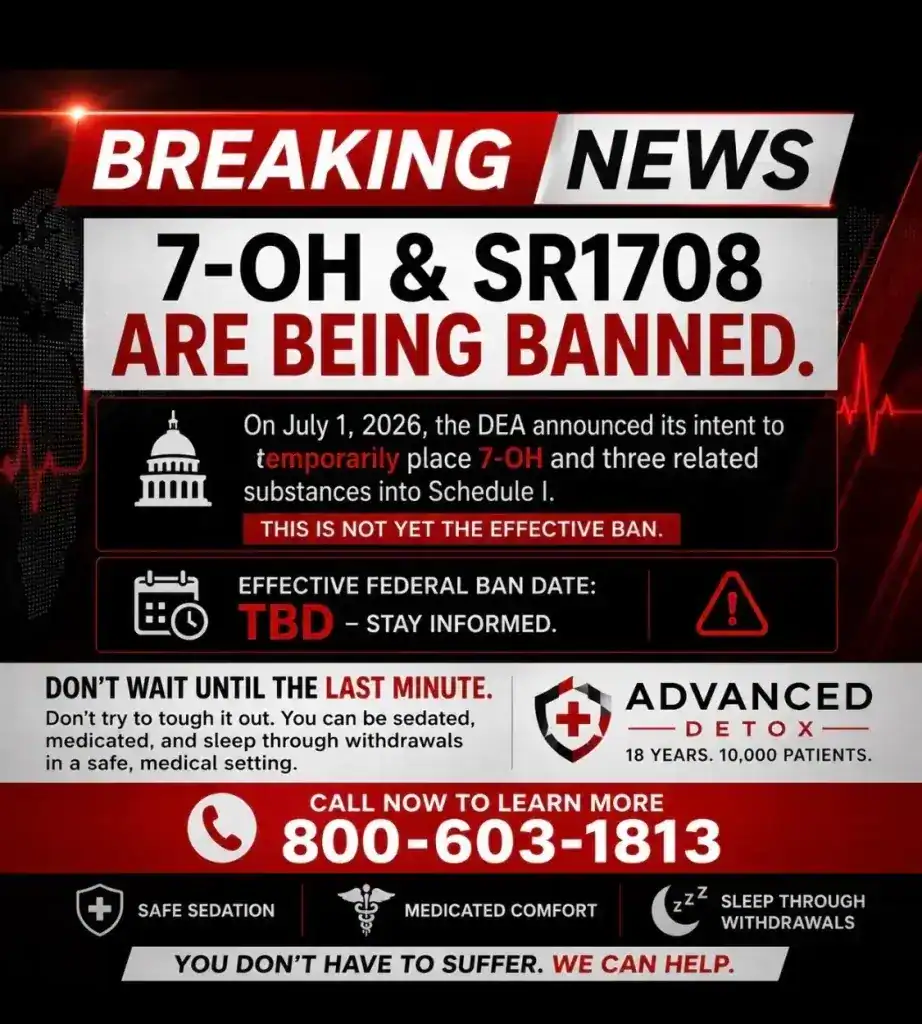
Important: On July 1, 2026, the DEA temporarily scheduled 7-OH and related substances as controlled substances citing opioid-like effects and concerns about overdose risk
Signs You May Need 7-OH or Kratom Detox
If you're using 7-OH or Kratom regularly, you may have developed physical dependence without realizing it. Here are common signs:
Physical Dependence Indicators
- Using daily or multiple times per day to feel "normal"
- Needing increasingly larger doses to achieve the same effect
- Experiencing withdrawal symptoms when you miss a dose or try to quit
- Unable to reduce your use despite wanting to stop
- Spending significant time and money obtaining products
Common Withdrawal Symptoms Include
- Severe muscle aches and body pain
- Intense anxiety, irritability, and mood swings
- Insomnia and restless sleep
- Nausea, vomiting, and digestive distress
- Excessive sweating and hot/cold flashes
- Fatigue and lack of energy
- Runny nose and watery eyes
- Strong cravings for the substance
- Depression and emotional instability
These symptoms can be severe enough to make quitting on your own very difficult.